eSIM for Osaka and Kyoto: A Kansai Travel Guide
Using an eSIM in Kansai: from Kansai Airport into Osaka and Kyoto, transit apps across JR and private railways, day trips, weak-signal spots and Tokyo or Korea.

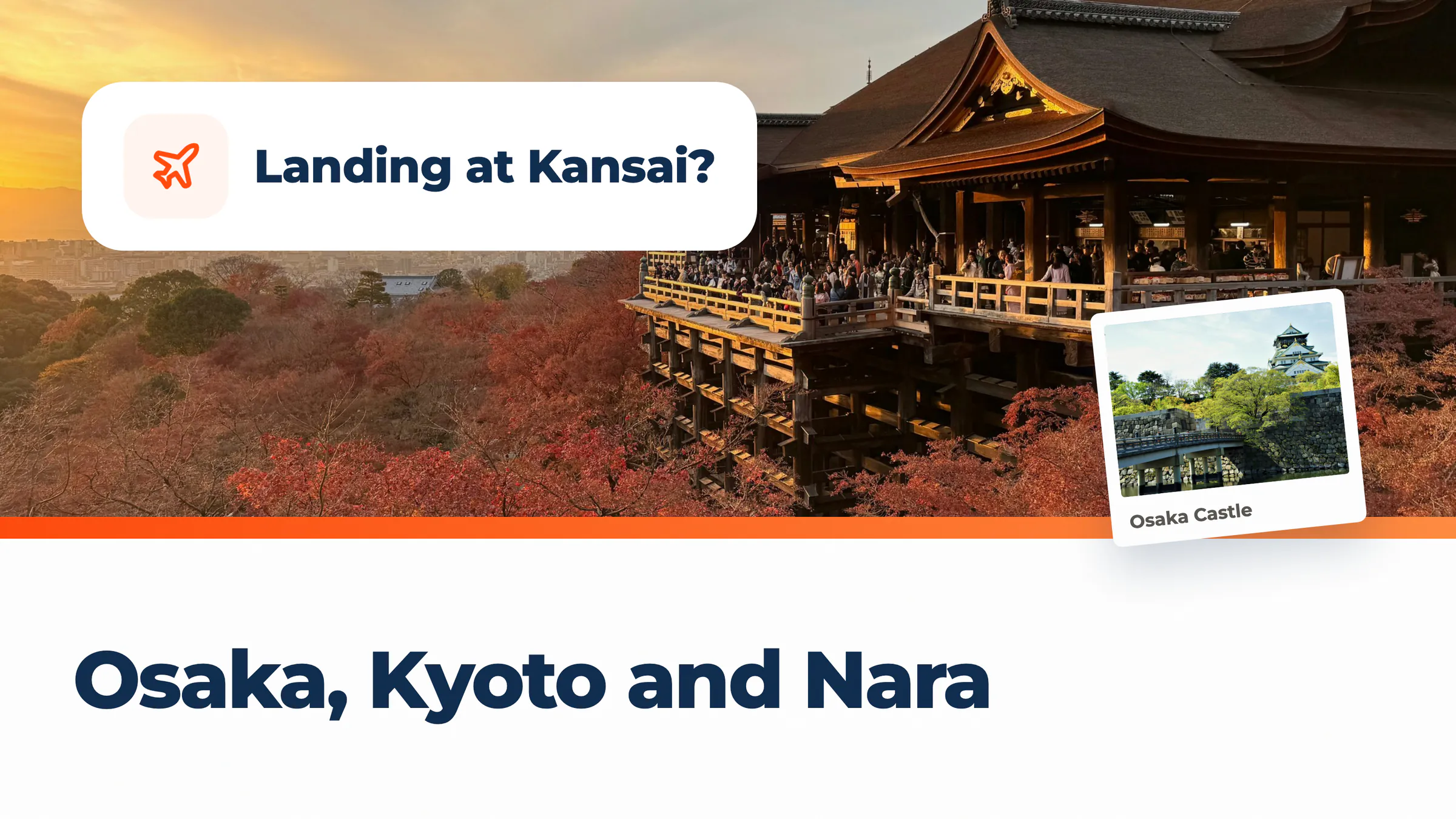
Kansai is a region you cover by train: Osaka for food and nightlife, Kyoto for temples, and day trips in every direction. An eSIM for Osaka keeps route planners, tickets and messages on your phone from the moment you land at Kansai Airport, and it works the same way in Kyoto, Nara and beyond.
This guide is about the Kansai side of a Japan trip: getting from the airport into the cities, handling a rail network run by several companies, day trips, places where the signal may weaken, and how to join Kansai with Tokyo or South Korea. For plans and coverage, see the Japan eSIM page.
1. Getting online at Kansai Airport (KIX)
1.1 Install at home, switch on as you land
Kansai International Airport sits on an artificial island in Osaka Bay, linked to the mainland by a bridge. Install the eSIM at home over Wi-Fi, then select it for mobile data and turn on data roaming for the eSIM line when the plane lands. Turn data roaming off on your home SIM line so your home carrier does not charge you. By the time you reach immigration you can message your hotel and check the train you need.
1.2 Into Osaka and Kyoto
Two rail companies serve the airport. JR's Haruka limited express runs towards Tennoji, Shin-Osaka and Kyoto, while Nankai trains, including the rapi:t, run to Namba in southern Osaka. Airport buses also go to major hotels and stations. Which one suits you depends on where you are staying, and a route planner with live data shows the next departure, the platform and whether you need to change.
2. Using maps and transit apps on Kansai's railways
Kansai's trains are not one system. JR West shares the region with Osaka Metro and private railways such as Hankyu, Keihan, Kintetsu, Hanshin and Nankai, and stations with similar names can belong to different companies. Route apps take care of this: they show which line to board, where to change and the fare. Hankyu, for example, runs from Osaka-Umeda to central Kyoto, while Keihan follows the river through Kyoto towards Gion and Fushimi Inari.
An ICOCA card, or another Japanese IC card, pays for most trains and buses across the region. In Kyoto, many sights are reached by city bus, and a live map helps you find the right stop and see which way the bus is going. Map use itself takes little data; our guide to Google Maps data usage gives a sense of how much.
3. Is an eSIM for Osaka enough for day trips to Nara, Kobe and Himeji?
Yes, a Japan plan covers the whole country, so the same eSIM for Osaka also works on every day trip. You do not need anything separate for Nara, Kobe or further west.
3.1 Nara
Nara is reached by Kintetsu or JR trains from both Osaka and Kyoto. The park, Todai-ji and the deer are in a compact area with good coverage, and a map helps you find the less crowded paths towards Kasuga Taisha.
3.2 Kobe and Himeji
Kobe is a short ride west of Osaka on JR, Hankyu or Hanshin. Himeji Castle is further along the same corridor, reachable by JR trains or the shinkansen. Both cities are well covered.
3.3 Hiroshima and Miyajima
The Sanyo shinkansen from Shin-Osaka makes Hiroshima a possible long day trip, or better an overnight stay. Miyajima is a short ferry ride from Miyajimaguchi. The line west of Kansai has many tunnels, so expect brief signal drops on the train; save your return ticket and ferry details before you set off.
4. Where can the signal weaken around Kyoto and Kansai?
Coverage in central Osaka and Kyoto is dense, including stations and shopping arcades. A few places popular with visitors are less predictable:
- Upper Fushimi Inari: the lower gates are busy and well covered; the wooded paths towards the summit can be patchier.
- Kurama and Kibune: the mountain trail between these villages north of Kyoto runs through forest and valleys.
- Mount Koya: the temple town is reachable, but the mountain approach and forest walks can lose signal.
- Kumano Kodo and the Kii peninsula: long walking routes with remote stretches.
Download offline maps before these outings and keep temple or ryokan details saved. A good eSIM for Kyoto day trips is one you have prepared for gaps, not one you expect to have none.
5. Combining Osaka, Kyoto and Tokyo in one trip
Many first trips link Tokyo and Kansai by the Tokaido shinkansen, which stops at Kyoto and Shin-Osaka. One Japan eSIM covers both ends, so there is nothing to change when you arrive. As on other lines, tunnels cause short drops on the way. If you fly into Tokyo and out of Kansai, or the other way round, choose a plan validity that covers every day in the country; the Japan eSIM plan table shows validity, hotspot support and whether a plan can be topped up.
If the trip also takes in Tokyo or other regions, our guide to choosing a Japan eSIM covers the rest of the country.
6. Pocket Wi-Fi rental or eSIM in Kansai?
Pocket Wi-Fi routers are still common in Japan. They can make sense for a group that always travels together, but they add a device to charge and carry, and the rental usually has to be returned before you fly home. When a group splits up, say some go to Nara while others shop in Osaka, only the person holding the router stays online.
| Question | eSIM | Pocket Wi-Fi rental |
|---|---|---|
| Extra device to carry and charge | No | Yes |
| Each traveller connected separately | Yes, one eSIM per phone | Only near the router |
| Pick-up and return | None, installed by QR code | Usually required |
| Sharing data | Phone hotspot, if the plan allows it | Built in |
Our full comparison of eSIM vs pocket Wi-Fi goes into more detail.
7. Adding South Korea or China to a Kansai trip
Kansai Airport has short flights to Seoul and Busan, and ferries between Osaka and Busan are another option (check current schedules), so a Japan and Korea trip is easy to plan. Instead of two separate plans, the Japan & South Korea eSIM covers both countries. If mainland China is also on the route, look at the China mainland, Japan and South Korea eSIM. Check the country list and plan details before you buy, and see our guide to eSIM for travel in Asia for longer routes.
8. Before you go: number, apps and setup
Our eSIMs are data-only, so you get mobile internet but no Japanese phone number. That is rarely an issue: LINE and WhatsApp work over data using your home number, and restaurant booking sites generally accept a foreign number. Keep your home SIM in the phone for bank codes. A short checklist:
- Confirm your phone supports eSIM and is unlocked.
- Install the eSIM over Wi-Fi before you fly.
- Download a transit app and offline maps of Osaka and Kyoto.
- Add an IC card to your phone if your device supports it, or buy one at the station.
- Try a free eSIM trial if you have never installed an eSIM, and see our travel eSIM range for other stops.
9. Frequently asked questions
Do I need a different eSIM for Osaka and Kyoto?
No, one Japan eSIM works in Osaka, Kyoto and the rest of the country. The plan covers Japan as a whole, not a single city.
Can I activate my eSIM for Osaka at Kansai Airport?
Yes, as long as it is installed beforehand you can switch it on when you land. Installing at home over Wi-Fi avoids depending on airport Wi-Fi.
Does the eSIM work on the shinkansen?
It works on most of the route, with short drops in tunnels. Save tickets and bookings before long rides.
Which network will my Japan eSIM use?
The plan details list the partner networks, currently KDDI/au and SoftBank. Coverage comes from those partner networks, so check the details of the plan you choose before you buy.
Is an eSIM for Kyoto useful if my hotel has Wi-Fi?
It is, because most of the day is spent outside: on buses, at temples and on trains. Hotel Wi-Fi only helps when you are back in your room.
Cover photo: Omkar Jori and Jeremy Santana on Unsplash
Was this article helpful?
Be the first to rate.

Written by
Richard Collins